 MARTINGALECALCULATOR.COM
Kim Birch works with probabilistic modeling and constraint-based simulations focused on gambling-adjacent systems. On martingalecalculator.com, his role is limited to defining mathematical assumptions, documenting model behavior, and preventing behavioral or prescriptive interpretation of abstract systems. The content reflects analytical scope only and does not evaluate or promote real-world use.
MARTINGALE SYSTEMS AS MATHEMATICAL MODELS, NOT BETTING ADVICE
This page defines how Martingale systems must be understood when presented in a computational or simulated form. The content here establishes the interpretive boundaries for all modeling on this site. It explains what a Martingale system represents in abstract terms and what conclusions cannot be drawn from its simulation.
The purpose is classification, not instruction. The presence of a model does not imply endorsement, recommendation, or applicability to real-world behavior.
1. Purpose of this page
This page exists to define how the Martingale calculator on this site must be interpreted. The calculator represents a mathematical system under explicitly stated assumptions. It does not describe behavior. It does not evaluate decisions. It does not imply endorsement of any real activity.
Misinterpretation is common when a formal system resembles familiar real-world patterns. This page exists to prevent that drift. The presence of a simulation does not transform a mathematical abstraction into guidance. Modeling a system does not imply endorsement of real-world application.
This page therefore functions as a classification boundary. It separates descriptive modeling from behavioral inference. All other material on the site must be read through this constraint.
Where this abstraction is instantiated as a computational tool, it appears only as the Martingale model implementation, which operates strictly within the limits defined here.
2. What a Martingale system is in abstract terms
A Martingale system, in abstract terms, is a rule-based progression defined by conditional repetition. It specifies how a sequence evolves based on the outcome of the immediately preceding step. Each state depends on the previous state, not on external context.
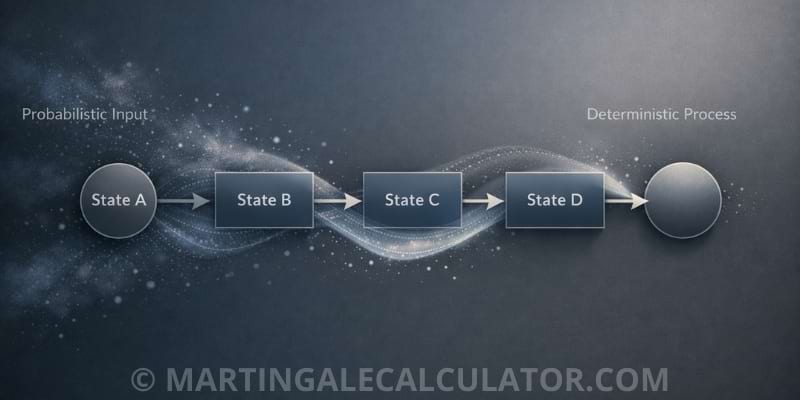
The defining features are sequential dependency and conditional progression. The rule itself remains constant. Only the state changes. This creates a deterministic structure layered on top of probabilistic events.
In this abstraction, the system is fully described by its progression rule and its boundary conditions. No interpretation beyond that structure is required. The model exists as a formal object. It does not require narrative framing.
3. Mathematical modeling versus real-world application
A mathematical model is an abstraction. It isolates selected variables and ignores others by design. This reduction is intentional. It allows properties of the system to be examined without contextual noise.
The Martingale calculator operates entirely within this abstraction. It assumes fixed probabilities, independent trials, and finite boundaries. These assumptions are declared. They define the scope of the simulation.
A mathematical model exists independently of how it may resemble real activities. Similarity does not imply equivalence. Abstraction removes context rather than approximating it. The calculator therefore describes internal system behavior under assumptions, not external behavior in uncontrolled environments.
4. Why simulation does not imply recommendation
Simulation is a descriptive tool. It allows observation of how a formal system behaves under repeated iteration. It does not express intent. It does not express preference.
In engineering, failure models are constructed to understand limits. Stress testing exists to quantify breakdown points. Loss modeling exists to expose vulnerability. None of these activities imply endorsement of failure or risk.
The same logic applies here. The presence of a simulator indicates analytical intent, not prescriptive intent. Modeling a system is a way to expose constraints. It is not a signal of desirability or suitability.
5. Common misinterpretations of Martingale calculators
One common misinterpretation is that a calculator provides guidance. This is incorrect. The calculator does not evaluate decisions. It evaluates a model.
Another misinterpretation is that the calculator optimizes outcomes. No optimization exists in the model. The progression rule is fixed. The simulation reveals consequences, not improvements.
A third misinterpretation is that the calculator suggests behavior. It does not. It contains no behavioral variables. All outputs are properties of the mathematical structure under stated assumptions.
These clarifications are necessary because resemblance can override precision. This page exists to correct that tendency.
6. Scope and limitations of the martingalecalculator.com tool
The scope of the tool is narrow and explicit.
What the tool does
-
It models progression depth under a defined rule.
-
It quantifies probability distributions associated with that progression.
-
It measures boundary outcomes in finite systems.
What the tool does not do
-
It does not predict outcomes.
-
It does not recommend actions.
-
It does not reduce uncertainty.
-
It does not alter probability.
All outputs are descriptive. They reflect internal properties of the model. No external interpretation is implied.
7. Relationship to probability theory and risk modeling
The Martingale model sits within probability theory and risk modeling as a constrained stochastic process. Expected value describes long-run averages under infinite repetition. Expected value is frequently misread as a stabilizing or outcome-defining property in Martingale discussions. The mathematical role of expected value, and its separation from finite-path behavior and boundary outcomes, is defined explicitly in Expected Value in Martingale Systems. Variance describes dispersion around those averages.
In finite systems, absorbing boundaries dominate behavior. Once a boundary is reached, the process terminates. This termination is a structural property, not an anomaly.
This behavior is formalized through risk of ruin, which describes the probability that a finite system reaches an absorbing boundary before a terminating success occurs.
The calculator exposes these relationships without formal notation. It illustrates how variance and finite boundaries interact within a deterministic progression layered on probabilistic outcomes. The intent is conceptual clarity, not theoretical instruction.
8. Why non-prescriptive framing matters
Framing determines interpretation. Language that implies action or evaluation introduces ambiguity. Ambiguity invites misclassification.
Non-prescriptive framing is therefore structural, not cosmetic. It reduces the risk of regulatory misinterpretation. It reduces user misunderstanding. It preserves the informational classification of the site.
Removing prescriptive language is a deliberate design choice. It aligns the presentation with the underlying intent. It ensures that the model remains a descriptive abstraction rather than a behavioral prompt.
9. How this page constrains interpretation of the site
This page defines boundaries. It establishes how all other content must be read. The calculator is subordinate to this definition.
No page on the site overrides this constraint. Explanatory text exists to support correct interpretation, not to expand scope. The model is primary. Interpretation is constrained.
This page therefore functions as an internal reference point. It anchors classification and limits inference.
10. Summary
-
Martingale systems are mathematical models.
-
Mathematical models describe behavior under assumptions.
-
Simulation does not imply recommendation.
-
The calculator quantifies boundary behavior in finite abstractions.
-
This site documents constraints, not outcomes.