MARTINGALE CALCULATOR
This Martingale Calculator models betting progressions based on your initial bet, total bankroll, target profit, and the selected casino game. The chosen game determines the probability assumptions used in the calculation.
The calculation shows how the stake size increases after consecutive losses and how many progression steps a finite bankroll can sustain before reaching a risk of ruin. The results are probabilistic and based on fixed assumptions about outcomes and win probabilities.
The calculator does not predict actual results or guarantee success. It quantifies risk, limitations, and possible outcomes within a Martingale betting progression.
Analysis Summary
-
Success Probability:
0.00%
-
Risk of Ruin:
0.00%
-
Maximum Loss:
$0.00
How the Martingale calculation works
The Martingale calculation models a deterministic betting progression under fixed probability assumptions. After each resolved loss, the stake size increases by a fixed multiple, typically a doubling, with the objective of recovering all prior losses plus the target profit upon a single win.
Each step in the progression represents one resolved betting outcome. A win resets the progression to the initial bet level. A loss advances the progression and increases the required stake size. The calculation continues until either a win occurs or the bankroll or table limit is reached.
All probabilities used are effective win probabilities for the progression. Outcomes that return the stake, such as pushes or ties, are excluded because they do not advance or reset the progression. Only resolved win and loss outcomes affect the calculation. The Martingale system is especially popular in roulette because even-money bets such as red or black, odd or even, and high or low make the progression easy to model, and you can test those roulette-specific scenarios on MartingaleRoulette.com.
Betting progression and probability
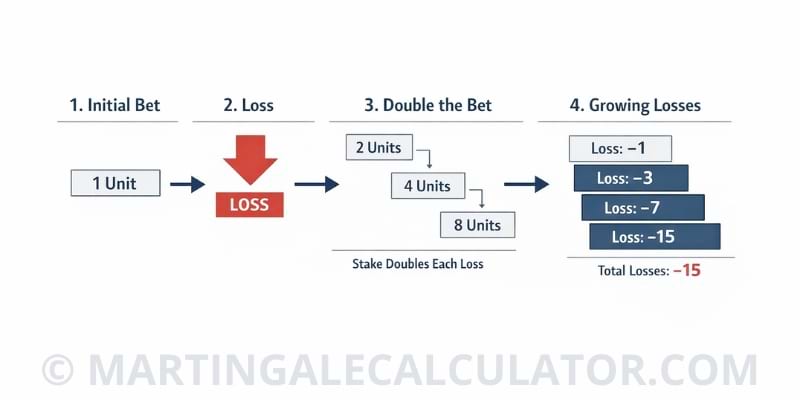
A betting progression is a sequence of increasing stake sizes conditioned on consecutive losses. The calculator computes this sequence explicitly and evaluates the probability of reaching each step under the assumed game probabilities.
The success probability represents the probability that at least one win occurs before the bankroll can no longer sustain the next required stake. The complementary probability represents failure, also referred to as risk of ruin.
Expected value is often misunderstood when interpreting probabilistic outputs. For a mathematical clarification of how expected value relates to Martingale systems and why it does not describe short-run outcomes or finite bankroll behavior, see Expected Value in Martingale Systems.
Risk of ruin and maximum loss
Risk of ruin is defined as the probability that the bankroll is exhausted or the next required stake exceeds the available bankroll or table limit before a win occurs. For the formal definition and model boundary conditions, see Risk of Ruin in Martingale Systems.
Maximum loss represents the total amount of bankroll committed if the progression reaches its deepest possible step without a win. This value is fully determined by the initial bet, the progression multiplier, and the finite bankroll constraint.
With a finite bankroll, the risk of ruin is always greater than zero. The calculator quantifies this risk under the stated assumptions but does not eliminate it.
Supported casino games and assumptions
The calculator supports multiple casino games by applying game specific effective win probabilities relevant to Martingale progressions.
European Roulette
Assumes even-money bets on a single-zero wheel (18 winning outcomes out of 37). The Martingale strategy in european roulette is a very popular strategy and a lot of players use it on red and black outcomes.
American Roulette
Assumes even-money bets on a double-zero wheel (18 winning outcomes out of 38).
Baccarat Banker
Tie outcomes are excluded from progression logic.
Baccarat Player
Tie outcomes are excluded from progression logic.
Blackjack
Assumes standard rules and the use of basic strategy. Push outcomes are excluded. Effective win probability reflects resolved hands only.
Coin flip
Used as a reference model with symmetric win and loss probabilities and no house edge. Included for comparative probability modeling only.
Limitations of the Martingale system
The calculation assumes fixed probabilities and independent outcomes. Real world casino play may deviate due to table limits, rule variations, and operational constraints.
The growth of stake size is exponential, while the bankroll is finite. This structural imbalance dominates outcomes and guarantees a non zero probability of failure.
The calculator does not account for behavioral factors, betting discretion, or changes in stake sizing outside the defined progression.
Kim Birch
Responsible for calculation logic and probabilistic assumptions.
Spanish version: Estrategia Martingala
Frequently Asked Questions
What does the success probability represent
It represents the probability of achieving the target profit before the bankroll can no longer sustain the next progression step.
Why does the martingale calculator ignore ties or pushes
Push and tie outcomes return the stake and do not advance or reset the progression. They are excluded to preserve progression relevant probabilities.
How is maximum loss calculated
Maximum loss is the sum of all stakes required to reach the deepest possible progression step supported by the bankroll.
Why do different games produce different results
Each game has a different effective win probability for resolved outcomes, which directly affects progression depth and risk of ruin.
Does changing the target profit affect risk
Yes. A higher target profit increases required progression depth and increases both maximum loss and risk of ruin.
 MARTINGALECALCULATOR.COM